
Picture this: you’re three hours into a drive to Dunsborough, the kids are finally quiet in the back, and you spot a kangaroo on the road ahead. Your foot moves to the brake, but the car’s already responding, beeping, flashing, slowing itself down before you’ve fully processed what’s happening.
That’s the kind of everyday reality the Subaru Forester is built for. Not dramatic off-road expeditions or speed records, but the actual driving most WA families do every week, school runs through congested suburbs, weekend trips down south, and the occasional gravel road to a campsite that looked much better on Instagram.
This review cuts through the marketing noise to examine what the Forester actually delivers for families living in Western Australia, where summer heat pushes 40 degrees, distances are measured in hours rather than kilometres, and a “sealed road” isn’t always a given.
Quick verdict for WA families
Here’s what you need to know upfront: the latest Forester does the mundane stuff really well. It’s not the most out there SUV you’ll test drive, but it might be the most sensible one.
The model that arrived in June 2025 carries a 5-star ANCAP safety rating, the independent benchmark that actually matters when you’re comparing medium SUVs. Every variant comes with proper all-wheel drive (not the pretend kind that only engages when you’re already sliding), and the cabin fits actual humans comfortably, including teenagers who insist they need more legroom than they really do.
What matters when you’re actually driving in WA
Let’s be honest about Western Australian driving for a moment. You’re either navigating Perth’s increasingly congested roads, or you’re covering serious distance on highways that get progressively more remote. Sometimes you’re doing both in the same weekend.
The Main Roads WA travel map becomes your best friend when you’re planning trips beyond the metro area, because conditions change fast out here. That sealed road to your favourite beach spot? It might be underwater after winter storms, or corrugated gravel after months of summer traffic.
The Forester doesn’t pretend to be a hardcore off-roader, but it acknowledges these realities. Standard all-wheel drive on every model, not just the expensive ones. Ground clearance that gives you options when the car park at Leeuwin-Naturaliste turns to mud. Technology that helps when you’ve been driving for four hours and your attention starts to wander.
These aren’t just fancy features. They’re just the sensible stuff you actually need.
Safety that goes beyond the brochure
The independent testing that actually counts
You know what’s refreshing? When the safety credentials aren’t just manufacturer claims echoing around a marketing department.
The current Forester scored 5 stars when ANCAP tested it independently, with particularly strong results for protecting adults and kids in a crash. ANCAP is Australia and New Zealand’s independent assessment authority, they buy vehicles anonymously, crash them into walls at various angles, and measure what happens to the test dummies inside.
It’s brutally objective, which is exactly what you want when you’re trying to separate genuine safety from clever advertising.
The Forester performed well in the tests that matter most: frontal crashes, side impacts, and how effectively its active systems prevent accidents before they happen. For families making one of the biggest purchases they’ll make this year, that independent verification means something real.
Technology that earns its keep
Subaru’s EyeSight system uses stereo cameras mounted behind the windscreen to watch the road ahead. Think of it as an extra set of eyes that never gets tired, distracted, or hypnotised by three hours of straight highway.
Pre-collision braking can step in if you don’t react fast enough to a stopped car ahead. Lane-keep assist provides gentle steering inputs if you drift toward the line without indicating. Adaptive cruise control maintains a set distance from the vehicle ahead, speeding up and slowing down as traffic flows.
None of this is revolutionary anymore, most modern SUVs offer similar features. What matters is how well it works in practice, and the EyeSight system has earned a solid reputation for being genuinely helpful rather than intrusive.
Vision Assist adds blind-spot monitoring and rear cross-traffic alert, which proves its worth every time you’re reversing out of a Coles car park with oversized utes blocking your sightlines.
On those long drives to Margaret River or Geraldton, when even the most attentive driver’s mind starts to drift, these systems provide a safety net. They’re not magic, and they don’t replace paying attention, but they catch the moments when human attention inevitably lapses.
Space and practicality for real families
The stuff that matters every single day
Open the rear door of a Forester and you’ll immediately notice something: you don’t have to be a contortionist to install a child seat. The door opens wide, the seat height is sensible, and there’s actual space to work.
This might sound trivial until you’ve wrestled with a rear-facing capsule in a “sporty” SUV with tiny door apertures and a low roofline. Small details like this separate vehicles designed for families from vehicles designed to look good in photographs.
Rear legroom is genuinely generous, tall teenagers won’t spend the entire drive to Busselton complaining their knees are jammed into the front seats. The boot is big enough for the weekly grocery shop, sports equipment, and the inevitable beach gear that somehow multiplies between visits.
Visibility is where the Forester really shines. Large windows, slim pillars, and an elevated seating position mean you can actually see what’s around you. Reversing cameras are great, but being able to turn your head and actually see someone walking on the footpath is better.
Getting child restraints right in WA
Every parent knows that installing child seats correctly is non-negotiable, but fewer know where to get help if they’re unsure.
The Forester provides ISOFIX anchor points in the rear outboard seats and top tether points across all three positions. The WA Government maintains current guidance on fitting child restraints and lists certified Type 2 Fitting Stations across the state.
Child seat manufacturers and vehicle designs vary, so even if the specifications look compatible, it’s worth having a professional check your specific combination. The Road Safety Commission provides clear guidance on age-appropriate restraint types and correct usage.
Getting this right matters more than almost any other decision you’ll make about the vehicle.
How it drives when roads are actually roads
All-wheel drive that works full-time
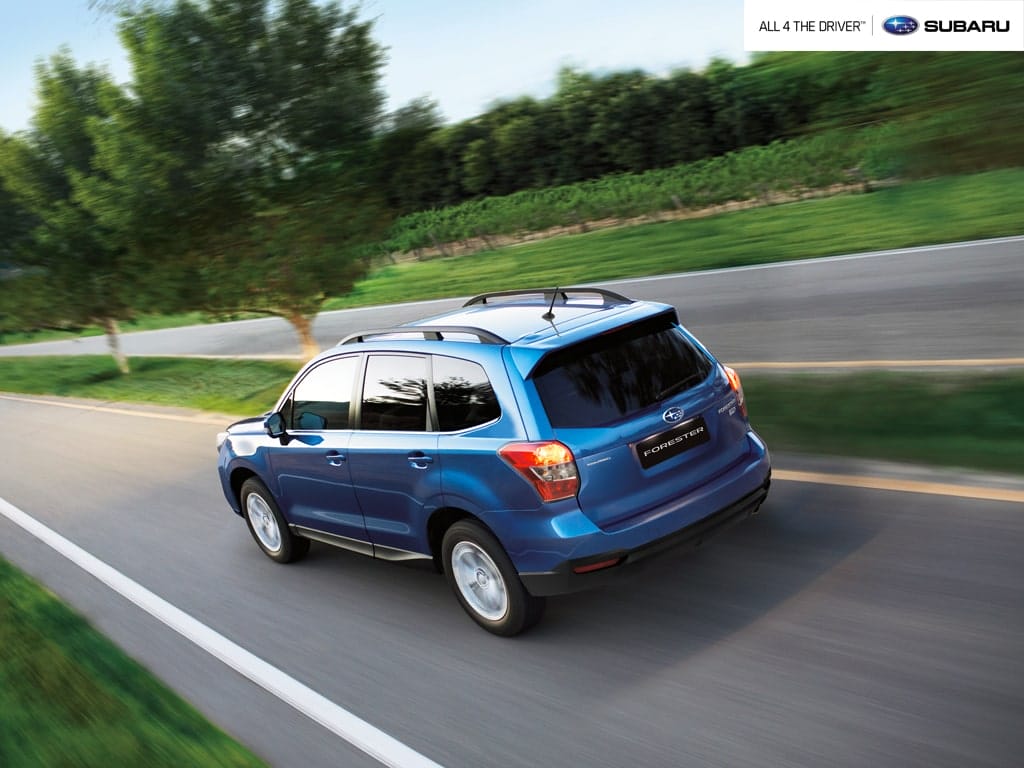
Here’s what sets the Forester apart from many competitors: every single variant comes with proper Symmetrical all-wheel drive, not a front-wheel-drive platform with an occasional AWD assist when sensors detect slip.
This matters in WA because our roads challenge traction more than you might expect. The first rain after a dry summer creates slippery conditions as oil residue lifts off the bitumen. Gravel roads to campsites don’t always cooperate. Beach access tracks turn to soft sand without warning.
The Forester’s system sends power to all four wheels all the time, with a mechanical bias that helps maintain momentum and composure when surfaces get challenging. Combined with 220 mm of ground clearance, it provides useful capability without the complexity or fuel penalty of a heavy-duty off-road system.
On sealed roads, it contributes to stable, predictable handling, particularly in wet conditions or when you need to brake hard while cornering. The low-mounted boxer engine keeps weight low and centred, which helps the SUV feel more planted than its tall profile suggests.
It’s not sporty, nobody will confuse the Forester with a hot hatch, but it’s composed, competent and confidence-inspiring. Which is exactly what you want when you’re carrying your family.
Driver monitoring that tries to help
Subaru’s driver monitoring system uses a camera to watch your face and can alert you if it detects fatigue or distraction.
Let’s be clear about what this is and isn’t. It isn’t autonomous driving, it doesn’t control the vehicle, and it absolutely doesn’t replace the need for breaks, coffee and responsible decisions about when to pull over.
What it does provide is a backup alert when you’ve been staring at straight highway for too long and your attention starts to drift. On regional WA drives where towns are separated by hypnotic stretches of road, that extra prompt to take a break might actually matter.
When the bitumen ends
X-MODE and what it actually does
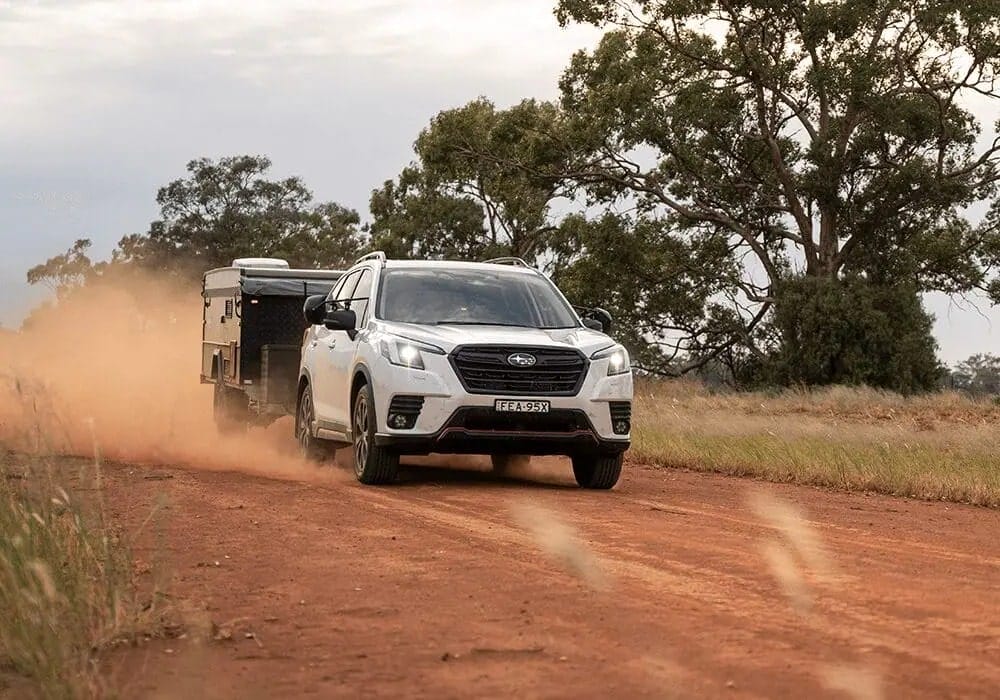
Push the X-MODE button and you’re telling the Forester you’re about to drive on something other than smooth bitumen. The system adjusts how aggressively the throttle responds, changes transmission shift patterns, and modifies the traction control to help maintain momentum without spinning wheels.
It’s genuinely helpful on beach access tracks, forest roads to campsites, and rutted paddocks at sports events. The 220 mm ground clearance provides margin for error when the track has deeper ruts than you expected.
Hill descent control deserves a specific mention: it maintains a controlled, low speed down steep declines without you touching the brake or accelerator. If you’ve ever navigated a steep, loose descent into a campsite while towing a trailer, you’ll immediately understand why this matters.
The Forester isn’t designed for rock crawling or extreme terrain, if that’s your weekend passion, you need a different vehicle. But for the kind of off-bitumen driving most WA families actually do, it’s capable and confidence-inspiring.
Beach driving done responsibly
WA beaches remain accessible in many locations, but access comes with responsibility. DBCA’s “Code Off Road” guidelines outline the basics: lower tyre pressures for soft sand (typically 16-18 PSI), keep speeds down, avoid sensitive dune areas and nesting sites, and respect seasonal closures.
National discussions in 2025 highlighted growing environmental concerns about beach driving impacts. Being a considerate user helps ensure these areas remain accessible for everyone.
RAC WA’s guide to four-wheel drive etiquette covers the unwritten rules of track courtesy, giving way on narrow sections, carrying recovery gear, and communicating your plans before heading remote.
The Forester handles beach driving well when conditions are reasonable. Soft, deep sand in summer might challenge it, but most family beach trips involve reasonably firm sand near the water line where the lower tyre pressures and AWD system cope comfortably.
Fuel economy and what you’ll actually spend
Understanding the official numbers
Let’s demystify fuel consumption figures. The official ADR 81/02 test is a standardised laboratory procedure that allows you to compare vehicles on a level playing field. For a 2025 Forester Hybrid variant, the Green Vehicle Guide shows a combined figure of 6.2 L/100 km.
That number is real, but it represents ideal conditions in a laboratory, not real-world WA driving with air conditioning blasting, kids in the back, and genuine hills.
The AAA’s real-world testing program has consistently found that many popular models consume more fuel on actual roads than their labels suggest. Their 2025 update found some vehicles using 30% more than advertised.
Use the official figure to compare vehicles, but expect your real-world consumption to be higher. For the Forester, realistic mixed driving with air conditioning and a typical load will likely put you closer to 8-9 L/100 km. Still competitive for a permanent AWD SUV, but more than the lab number promises.
Saving money at the bowser
Here’s a free tip that’ll save you more over a year than most optional extras: use FuelWatch religiously.
Perth’s fuel prices follow a predictable weekly cycle. Fill up on the cheap day and you’ll save 20-30 cents per litre compared to the expensive day. Over a year of family driving, that’s hundreds of dollars staying in your pocket.
For regional trips, plan fuel stops before you leave, distances between towns are real out here, and the last thing you need is fuel anxiety when you’re exploring the Coral Coast.
Towing for family adventures
The legal stuff you actually need to know
If you’re towing in Western Australia, here’s the number that matters most: 100 km/h. That’s your maximum speed when towing, regardless of posted limits. It’s not a guideline, it’s the law, and it applies whether you’re towing a small trailer or a full caravan.
WA’s Department of Transport explains the requirements clearly: trailers with a Gross Trailer Mass of 750 kg or more must have brakes unless specifically exempted.
Staying within the Forester’s limits
Always check the specific towing capacity for your exact Forester variant before hooking up. The manufacturer’s specifications vary depending on model and drivetrain, and exceeding them affects handling, braking, warranty coverage, and safety.
Tow ball download, Gross Vehicle Mass and Gross Combined Mass all matter. Your owner’s manual has the definitive numbers, read them, understand them, and stay within them.
Ownership costs beyond the purchase price
Warranty that removes worry
Subaru’s 5 year, unlimited kilometre warranty is genuinely useful in WA, where families regularly cover serious distances. The unlimited kilometre aspect means you’re not watching the odometer nervously if you’re doing regional trips or have a long commute.
Specific conditions apply for commercial use, so check the full warranty details if you’re considering using the vehicle for business purposes.
Service intervals and costs
Subaru recommends servicing every 12 months or 12,500 km for Forester models from MY21 onwards, whichever comes first.
These intervals are more frequent than some European competitors, but they’re typical for Japanese manufacturers and suit WA’s harsh conditions. Heat, dust and long-distance driving stress fluids and components more than gentle suburban use.
Capped-price servicing and prepaid service plans remove the uncertainty around maintenance costs. The prepaid plans typically offer modest savings compared to paying for each service individually, and they transfer with the vehicle if you sell privately during the coverage period.
Check the service plan calculator for your specific Forester grade to understand the total cost of ownership over three or five years.
How it compares to the usual suspects
Versus Toyota RAV4
The RAV4 brings hybrid efficiency and Toyota’s legendary reliability reputation. It’s a strong choice, particularly if you’re doing mostly urban driving where the hybrid system delivers genuine fuel savings.
But here’s the thing: many RAV4 variants use front-wheel drive, with AWD available only on specific models. If you regularly encounter wet or unsealed roads, the Forester’s standard AWD on every variant provides more capability without forcing you into a higher-spec grade.
Both are sensible family SUVs. The RAV4 might save you fuel money if you’re city-focused. The Forester gives you more capability if you venture off sealed roads regularly.
Versus Mazda CX-5
The CX-5 delivers a more upmarket cabin feel and sharper handling, it’s the choice if you value premium touches and driving enjoyment on sealed roads.
The Forester counters with more interior space, better visibility, and more ground clearance. It’s less refined on bitumen but more practical for families who need versatility. Think of the CX-5 as the stylish city option, the Forester as the practical family workhorse.
Versus Nissan X-Trail
The X-Trail’s e-POWER system offers EV-like smoothness, and seven-seat configurations suit larger families. If you need three rows, the X-Trail is your answer.
For five-seat families, the Forester’s proven mechanical AWD system, stronger ANCAP credentials, and more robust engineering make it a better long-term choice for WA conditions. The X-Trail is smoother and more spacious; the Forester is more capable and confidence-inspiring on challenging roads.
Common questions from WA drivers
Is the current Forester genuinely 5-star ANCAP rated?
Yes, the model introduced in June 2025 achieved 5 stars, providing independent verification of its crash protection and active safety performance. It’s not marketing, it’s measurable.
What fuel consumption should I actually expect?
Use the official figures to compare vehicles, but expect your real-world consumption to be higher, likely 8-9 L/100 km in mixed WA driving with air conditioning and typical loads. The AAA’s testing consistently shows most vehicles consume more on real roads than laboratory tests suggest.
Can I drive it on WA beaches?
Yes, where permitted, but reduce tyre pressures for soft sand, keep speeds down, and follow DBCA guidelines and local signage. Check for seasonal closures and respect nesting areas and protected dunes.
What’s the maximum speed when towing in WA?
100 km/h or the posted limit, whichever is lower. It’s legally required, not optional, regardless of your vehicle’s capabilities.
Your next step with Perth City Subaru
The Forester has built its reputation by doing the unsexy fundamentals properly: safety that’s independently verified, practicality that works every day, and genuine capability when conditions deteriorate.
It’s not the most exciting SUV you’ll test drive this month. It probably won’t make your heart race or turn heads at the school drop-off. But it might be exactly what your family actually needs, reliable, capable, and sensible, without unnecessary complexity or cost.
The only way to know if it suits your family is to experience it on the roads you actually drive. Book a test drive at Perth City Subaru, bring the kids, throw some gear in the boot, and see if the practicality translates to your real life.
Browse current specifications and pricing on our Forester page, or contact our team to discuss your specific needs and arrange a demonstration that includes the conditions that matter to you.
Because the right vehicle isn’t the one that looks best on paper, it’s the one that fits the driving you actually do, day after day, for years to come.